
Observations on the Old Stone Jail
at Hanover Courthouse
Jerrilynn Eby & Rick MacGregor
Stafford County historians, who are studying sandstone deposits, quarrying techniques and construction methods, met with Society President Art Taylor at the Old Jail to examine the stone structure. The following is an abstract of their report which provides insight into the construction of the historic building. Hanover Co. Historical Society Bulletin No. 103 (Spring 2021).
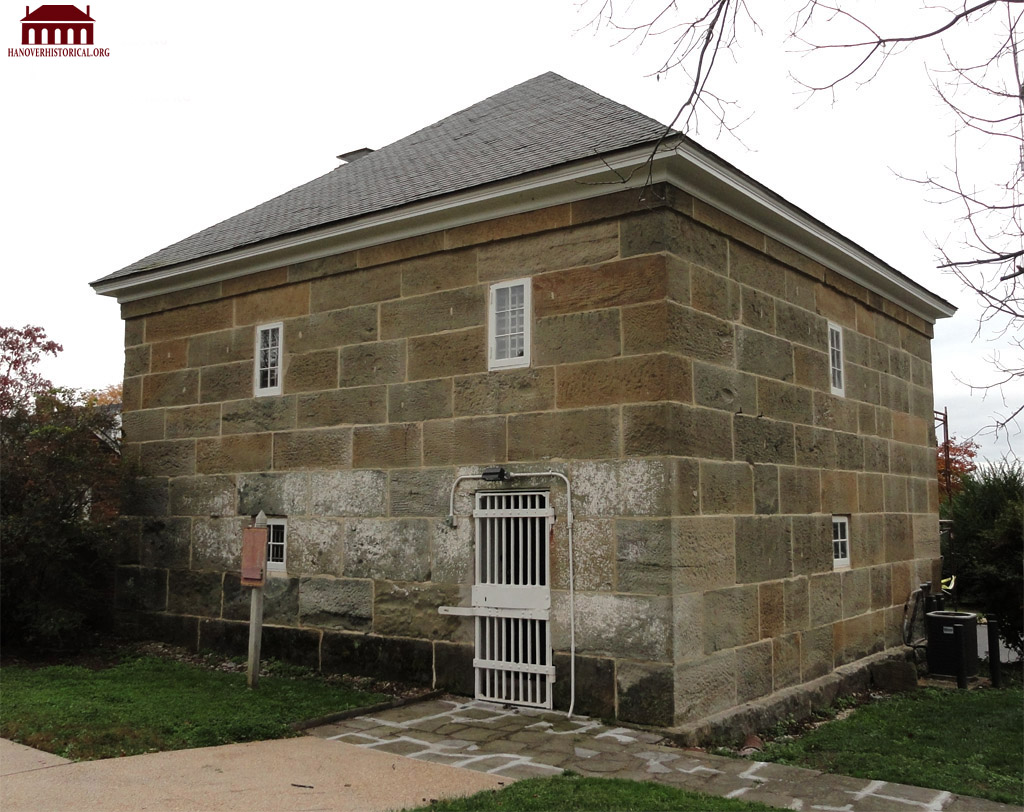
The Hanover County Jail appears to be constructed of a type of sandstone generally known as Aquia stone or freestone because it was first known to be quarried on Aquia Creek in Stafford County. Geologists designate this as part of the Potomac Formation which runs in a narrow belt from the Potomac River southward, passing through the several counties including Hanover, to nearly the James River. Stone outcrops have been found on Shockhoe Creek near the James River. Aquia freestone outcrops were noticed by Colonial settlers because they had been working with nearly identical material in England. By 1791, this stone was selected for the new capital city; the White House and Capitol were the first two structures in the city to be built with this material. The stone was also quarried and shipped to other cities along the east coast.
Aquia stone can vary in color from white, light grey, tan or rosy beige. The rather distinctive hues are the result of microscopic feldspar and iron particles. In some cases, the stones nearly white when first quarried, but takes on a tan or pale rosy color as the iron particles oxidize. Some of the stone in the Hanover Jail is slightly greenish in color which may be due to the presence of some other mineral. This stone has long been a popular building material because it is relatively soft when cut and quarried, easily worked and durable. The methods used in quarries were ancient – one needed little more than a pick and perhaps a wedge, hammer and chisel. As quarrying became an industry, more specialized tools were made, but all were of the tried-and-true ancient designs.
The Hanover Jail was constructed with exceptional care. Each block was picked square and laid in courses of uniform thickness rather than using randomly-sized blocks or with stone rubble which was a common practice in utilitarian buildings. Tool marks show that some of the blocks were also dressed with chisels, and additional finish work was done to the edges of many of the blocks.
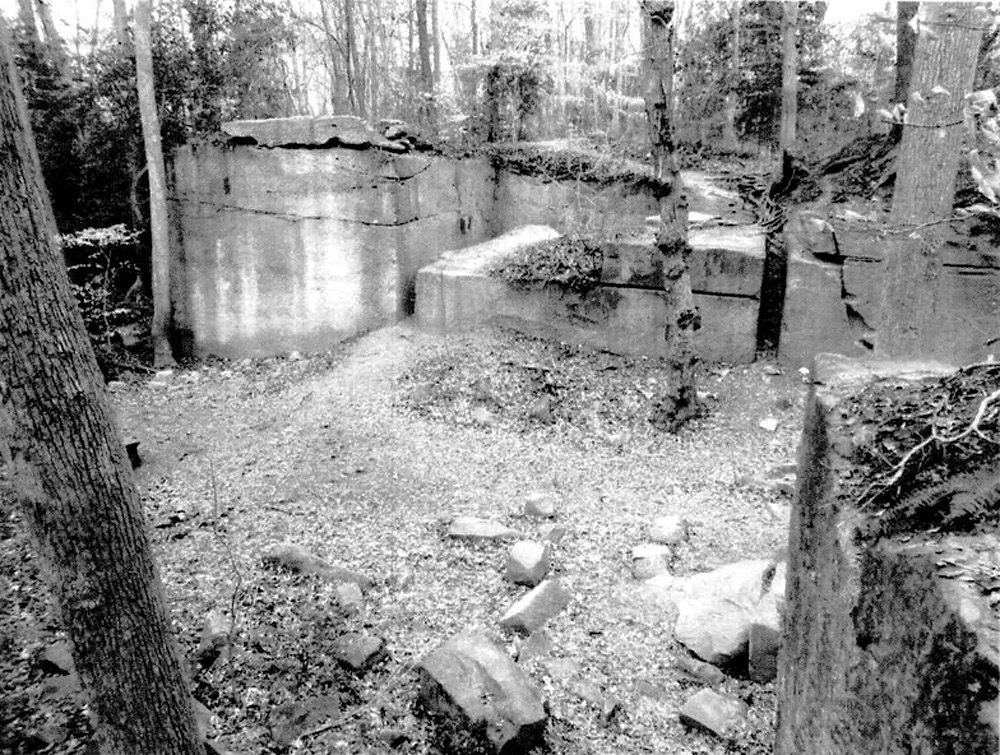
One of the quarry pits on Brent’s Island in Stafford County. The channel describing the length and width of a block is still obvious as is the horizontal groove into which iron picks could be hammered to cause smaller blocks to split.
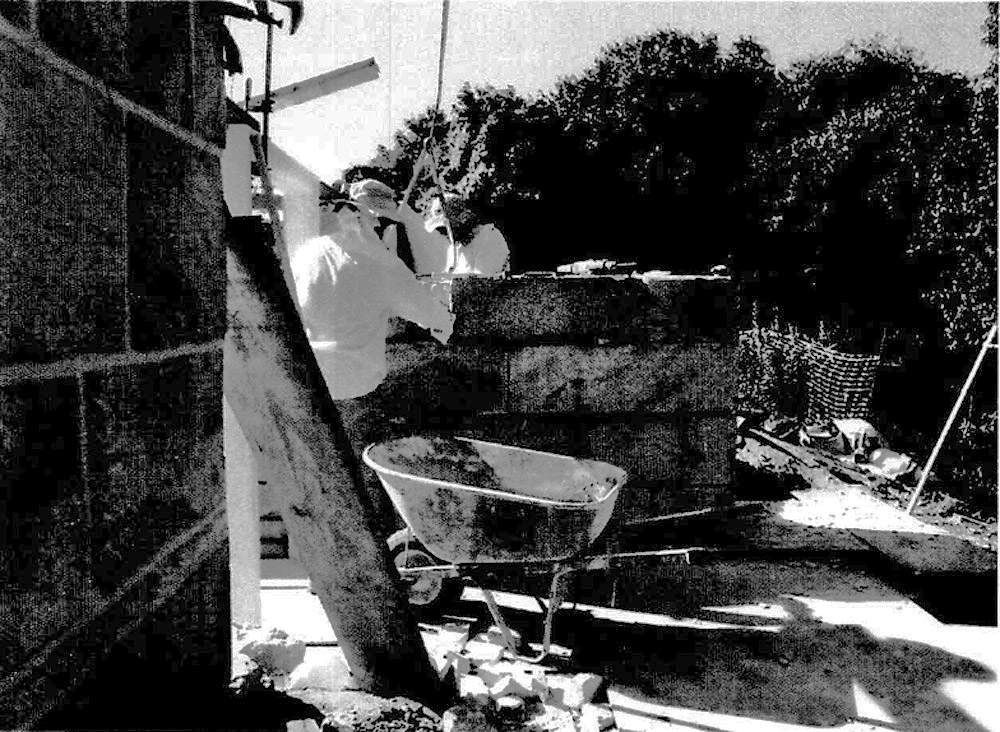
Many of the blocks retain angled holes that were drilled for the purpose of lifting them. A small crane or boom was likely located at the building site to assist the masons. Once a layer of mortar was applied and leveled, the crane, fitted with a set of tongs, lifted a block and set it carefully in place. While the holes appear to be upside down, they are, in fact, oriented correctly. The tongs were designed to pinch the block to lift it, and once tension was removed from the tongs, they slipped easily from the holes. Blocks drilled in the same manner were found during reconstruction of the foundation of the Washington house at Ferry Farm.
Aquia freestone blocks being set on the reconstructed foundation of the Washington house at Ferry Farm, Stafford County. Note the tongs that have just been used to place one of the blocks.
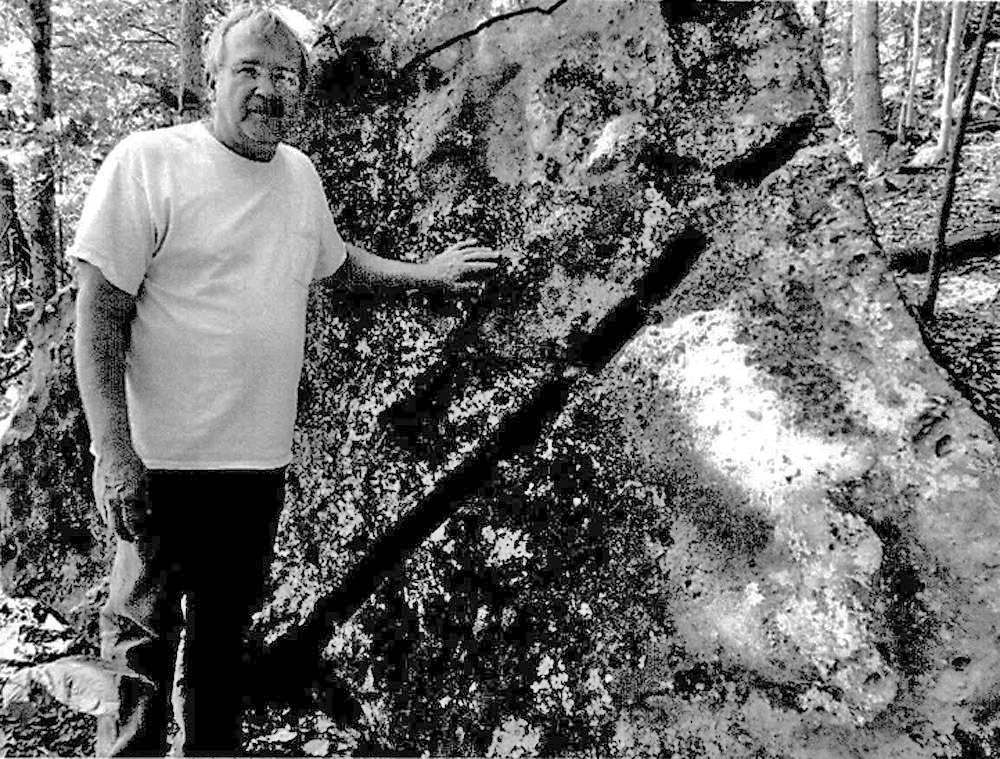
Also visible in a number of blocks at the Jail is scarring from the drilling process. Because the half-round scars are small and short, it is possible that plugs and feathers (also called wedges and shims) were used to split already quarried stone into blocks of the desired size. If the quarry from which this material came is located, surviving tool marks there will likely reveal the method used to extract them.
Photograph taken at Gibson’s Quarry on Aquia Creek in Stafford County.